


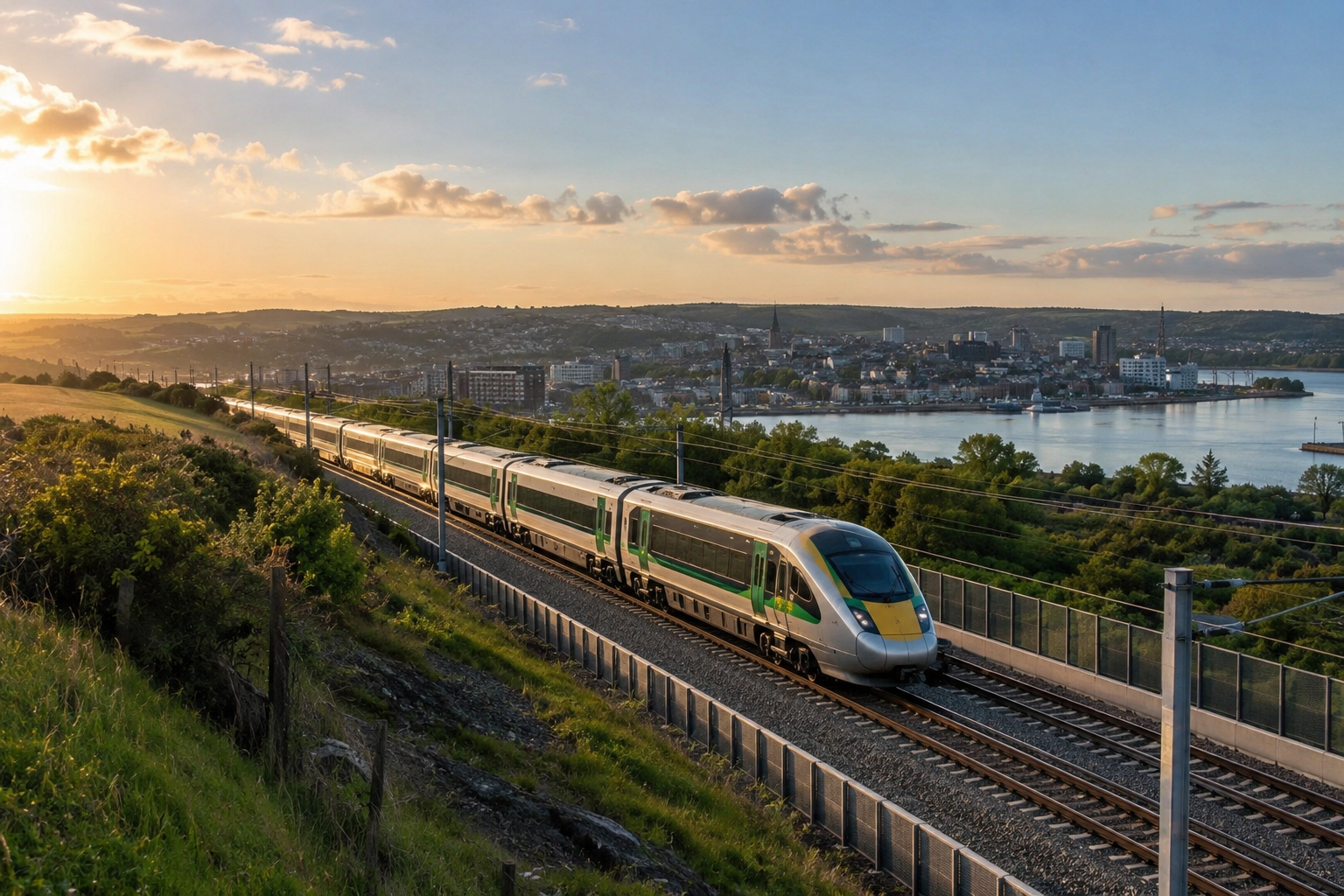
Imagine living in Cork but taking a job in Dublin without immediately wondering whether you would have to move.
Imagine a major employer opening an office in Limerick because access to Dublin was no longer considered a disadvantage.
Imagine finishing work in one Irish city and being home in another before you would currently have made it through the worst of the motorway traffic.
And imagine looking at a construction job in another county and thinking about the project itself before thinking about the commute.
That is the bigger question behind high-speed rail in Ireland.
It is easy to think of faster trains as simply a transport upgrade. A journey takes two hours today; build a better railway and perhaps it takes considerably less.
But infrastructure rarely works like that.
Change the time it takes to move between places and you can change where people live, where companies invest, where construction happens and, ultimately, how the country develops.
And Ireland is already beginning to think along those lines.
Ireland's Rail Network Could Look Very Different by 2050
Ireland is not currently preparing to build a Japanese-style bullet train network from scratch.
What is being considered is arguably more relevant.
The All-Island Strategic Rail Review sets out a long-term vision for rail across Ireland and Northern Ireland, including upgrading core intercity routes to support speeds of up to 200 km/h, electrifying much of the intercity network, increasing frequencies and expanding the railway into areas that currently have limited or no rail access.
The vision includes Dublin, Cork, Belfast, Limerick, Galway, Waterford and Derry/Londonderry as part of a much better connected intercity network.
If fully implemented, the railway network would grow from roughly 2,300 km to almost 3,000 km, while around 700,000 additional people would live within 5 km of a railway station.
Some intercity journey times could potentially be cut dramatically.
So the interesting question isn't simply:
Would people use faster trains?
It is:
What happens to Ireland when distance starts to matter less?
Cork Doesn't Move Closer to Dublin. But Economically, It Might.
Take Cork and Dublin.
Today, distance affects almost every decision surrounding the two cities.
It affects where somebody accepts a job.
It affects where businesses establish offices.
It affects where people buy homes.
It affects where contractors source workers.
It affects whether somebody considers commuting realistic.
But kilometres aren't really the problem.
Time is.
A city that is 250 km away but quickly and reliably accessible can, in practical terms, feel closer than somewhere considerably nearer with poor transport connections.
That is one of the most interesting consequences of a genuinely fast Irish rail network.
Instead of Ireland operating as several relatively separate employment markets, our cities could become much more closely connected.
Suddenly the person living in Portlaoise, Thurles, Athlone or Mallow isn't necessarily choosing exclusively from opportunities in their immediate area.
Their realistic employment radius becomes larger.
And that could have major implications for the Irish construction jobs market.
Your Job Search Could Stop Being Defined by Your Commute
Construction professionals know this problem particularly well.
A fantastic project can become a poor opportunity because of where it is located.
An Engineer might love the contractor, salary and project but face 90 minutes each way.
A Quantity Surveyor may reject an otherwise excellent position because the site is simply too difficult to reach.
A Project Manager might accept a role closer to home even though another opportunity would offer better long-term progression.
Location has enormous influence over careers in construction.
A better rail network wouldn't eliminate that problem. Construction sites, unlike offices, aren't conveniently positioned beside railway stations.
But it could redraw the map.
Major projects located around well-connected regional hubs would suddenly have access to much larger pools of construction talent.
And that creates another interesting possibility.
Companies might start following the workers rather than expecting the workers to follow the companies.
Would Dublin Lose Some of Its Gravity?
For decades, Dublin has exerted enormous economic pull.
Jobs attract people.
People attract investment.
Investment attracts development.
Development attracts more jobs.
It becomes a cycle.
High-speed rail could weaken the idea that economic opportunity has to be concentrated in one place.
Imagine Galway, Limerick, Cork and Waterford connected by faster, more frequent services not simply with Dublin, but increasingly with one another.
A company considering its next office, manufacturing facility, research centre or operations base could look differently at regional Ireland.
And once businesses begin investing, construction follows.
Offices need building.
Housing is required.
Schools follow population.
Hotels, healthcare facilities, logistics centres, roads, utilities and public infrastructure follow economic activity.
The railway itself may be the headline project.
The development it unlocks could be the bigger story.
A Railway Station Could Become One of the Most Valuable Pieces of Infrastructure in a Town
This is where the idea becomes particularly interesting for construction.
Picture a regional town receiving a station on a substantially upgraded railway.
Initially, the obvious investment is the railway itself.
Track.
Bridges.
Platforms.
Stations.
Electrification.
Signalling.
But then something else begins happening.
Land within walking distance of the station becomes more attractive.
A developer sees an opportunity for apartments.
A hotel follows.
Retail becomes more viable.
Employers realise their workforce can reach the town from further away.
Demand for housing increases.
The transport project starts creating construction projects that weren't part of the original railway budget.
This effect is often described as transit-oriented development: concentrating homes, employment and services around high-quality public transport.
For Ireland, it could provide another way of thinking about regional development.
Instead of asking how we convince more people and businesses to locate outside Dublin, we could ask:
What if we made regional locations dramatically easier to reach?
It Could Change Where People Can Afford to Live
There is another side to this.
Housing.
If someone needs to work in Dublin several days each week, living significantly outside the capital can mean exchanging cheaper housing for a punishing commute.
Faster rail changes that calculation.
Towns further from Dublin become more realistic options.
The same principle could apply around Cork, Galway and Limerick.
That doesn't mean high-speed rail would solve Ireland's housing problems.
It wouldn't.
But transport determines how much land is realistically connected to employment.
Improve that connection and the geography of the housing market starts changing.
There is, however, a catch.
Better connections can also push property values upwards around stations.
The town that becomes more accessible also becomes more desirable.
Without enough housing construction around those transport links, improved infrastructure could simply create another source of demand without enough supply.
Rail and housing policy would therefore have to work together.
The Construction Opportunity Would Be Enormous
Then there is the actual challenge of building it.
A faster, electrified, higher-capacity railway network would represent decades of work across Irish civil engineering and construction.
It wouldn't simply require railway engineers.
It would create demand across:
-
Civil and structural engineering
-
Project and construction management
-
Quantity surveying
-
Mechanical and electrical engineering
-
Health and safety
-
Environmental engineering
-
Utilities
-
Bridges and structures
-
Groundworks
-
Signalling and communications
-
Electrical infrastructure
-
Stations and associated developments
Much of Ireland's existing railway infrastructure would need significant upgrading.
Single-track sections would need additional capacity. Routes would require electrification. Stations would need redevelopment. Bridges, signalling systems and junctions would need work.
The All-Island Strategic Rail Review proposes upgrading much of the single-track cross-country network to double track, with four tracks in certain areas, alongside higher frequencies and electrification.
For the Irish construction industry, therefore, a serious rail programme wouldn't represent one megaproject.
It could represent an entire generation of infrastructure work.
Ireland Is Still a Car Country
There is one fairly large obstacle to this vision.
We like our cars.
CSO figures show that driving remains the dominant way Irish people travel to work. In 2022, 59% of workers drove to work, with car dependency considerably higher in some rural areas.
Only a relatively small proportion currently commute by rail.
So simply constructing faster trains wouldn't automatically transform behaviour.
The service would have to be good enough to make people willingly leave the car at home.
That means frequency matters.
Reliability matters.
Price matters.
Connections matter.
Station parking matters.
Local buses matter.
And the last few kilometres between the railway station and somebody's workplace matter enormously.
A 70-minute intercity journey isn't particularly useful if another 45 minutes is spent trying to complete the final part of the trip.
A high-speed railway therefore only becomes transformative when the infrastructure surrounding it works too.
And Then There Is the Cost
None of this would be cheap.
Major rail infrastructure involves land acquisition, planning, environmental assessments, bridges, tunnels, track, signalling, electrification, stations and rolling stock before a passenger ever boards a train.
Ireland would also face a fundamental choice.
Do we build entirely new dedicated high-speed railway lines?
Or progressively upgrade the network we already have?
The current national direction leans heavily toward the second approach.
The All-Island Strategic Rail Review proposes speeds of up to 200 km/h on the core intercity network rather than the 300 km/h-plus services associated with countries such as France or Japan.
That may sound less dramatic.
For Ireland, it could actually be more important.
The objective doesn't necessarily need to be owning Europe's fastest train.
It needs to be making rail competitive with driving.
If a train becomes the easiest, most reliable and quickest way of moving between Ireland's major cities, behaviour starts changing regardless of whether anybody calls it a "bullet train".
The Most Important Change Might Not Be Transport at All
This is perhaps the most interesting part of the whole discussion.
A successful high-speed or higher-speed rail network wouldn't ultimately be about trains.
It would be about time.
Reduce the time between Cork and Dublin and you haven't physically moved either city.
But you have changed their relationship.
Do the same between Dublin and Belfast.
Between Dublin and Galway.
Between Cork and Limerick.
Between regional towns and major employment centres.
Suddenly Ireland begins to feel smaller.
And a smaller Ireland creates bigger possibilities.
Workers can access more jobs.
Employers can access more workers.
Developers can consider more locations.
Regional cities can compete for more investment.
Construction activity can spread beyond existing hotspots.
And people may have more freedom to decide where they actually want to live.
So, What Would Ireland Look Like With High-Speed Rail?
Probably not like Japan.
And perhaps that shouldn't be the ambition.
The more interesting version is an Ireland where living outside Dublin doesn't automatically mean having fewer career opportunities.
Where Cork, Galway, Limerick, Waterford and Belfast feel like parts of a connected economic network rather than distant individual markets.
Where major railway stations become centres for new housing and commercial development.
Where construction professionals can consider opportunities across a wider geographical area.
And where the question "How far away is it?" gradually becomes less important than "How long does it take to get there?"
That future is still a long way from being realised.
But it isn't entirely imaginary.
Ireland's All-Island Strategic Rail Review already sets out recommendations through to 2050 for faster trains, electrification, additional track capacity, new routes and more frequent services. The Government subsequently published a Rail Project Prioritisation Strategy in December 2025 to consider how those recommendations should be sequenced.
Which means the question may no longer simply be:
What would Ireland look like with a high-speed rail network?
Get in Touch
Want to find out how we can help your business grow? Get in touch with us by sending a message through this form!Related Articles

3 Must-Ask Questions to End Your Construction Interview
3 Must-Ask Questions to End Your Construction Interview When it comes to construction interviews, most candidates spend all their time preparing to answer tough questions. While that’s important...
 Cathal McKeever
Are Construction Professionals Expected to Sacrifice Too Much?
Are Construction Professionals Expected to Sacrifice Too Much? Long hours. Long commutes. Constant pressure. Time away from family. ...
 Fionn Mac Néill
Are Data Centres the Golden Ticket? The Truth Behind Ireland's Most Talked-About Construction Sector
Are Data Centres the Golden Ticket? Walk into almost any construction site canteen, recruitment office, or industry event in Ireland today, and you'll hear the same conversation. ...
 Ryan Kieran
Are Your Construction Skills More Valuable Than You Think?
You'd Likely Be in Strong Demand Right Now When was the last time you stopped to think about your career? For most construction professionals, the answer is probably "not recently." Betwe...
 Stephen Nugent
Balancing Commute, Site Location & Career Growth in Ireland: Are You Optimising Your Construction Career?
The Decision That Can Shape Your Entire Construction Career It's Monday morning. Your alarm goes off at 5:15am. By 6am you're on the M50, heading towards a project that's over 90 minutes away. You tel...
Stephen Nugent
Breagh Recruitment: 10 Years in Construction Recruitment
Breagh Recruitment: 10 Years in ConstructionRecruitment – My Journey This October 2025, Breagh Recruitment turns ten and I couldn’t be prouder. But our story started long before the f...
Cathal McKeever
Breagh Recruitment 2025: A Year of Growth, Grit and Milestones
Breagh Recruitment 2025: A Year of Growth, Grit and Milestones As 2025 comes to a close, it’s a natural time to pause, reflect, and take stock of just how far Breagh Recruitment has come not jus...
Cathal McKeever
Breagh Recruitment Celebrates Excellence at the Irish Construction Industry Awards 2025
Breagh Recruitment had the privilege of attending the Irish Construction Industry Awards 2025 at the Convention Centre Dublin. It was a memorable even...
Cathal McKeever
Built by Humans, Run by Robots: The Engineering Wonder That Is Yangshan Port
Built by Humans, Run by Robots: The Engineering Wonder That Is Yangshan Port At Breagh, we live and breathe construction and engineering. But every now and then, we come across a project that makes ev...
Cathal McKeever
Career Path as a Mechanical Engineer in Ireland: Roles, Salaries and Timelines
Career Path as a Mechanical Engineer in Ireland: Roles, Salaries and Timelines If you're starting out in Mechanical Engineering or looking to progress to the next level, having a clear roadmap can mak...
Stephen Nugent
