


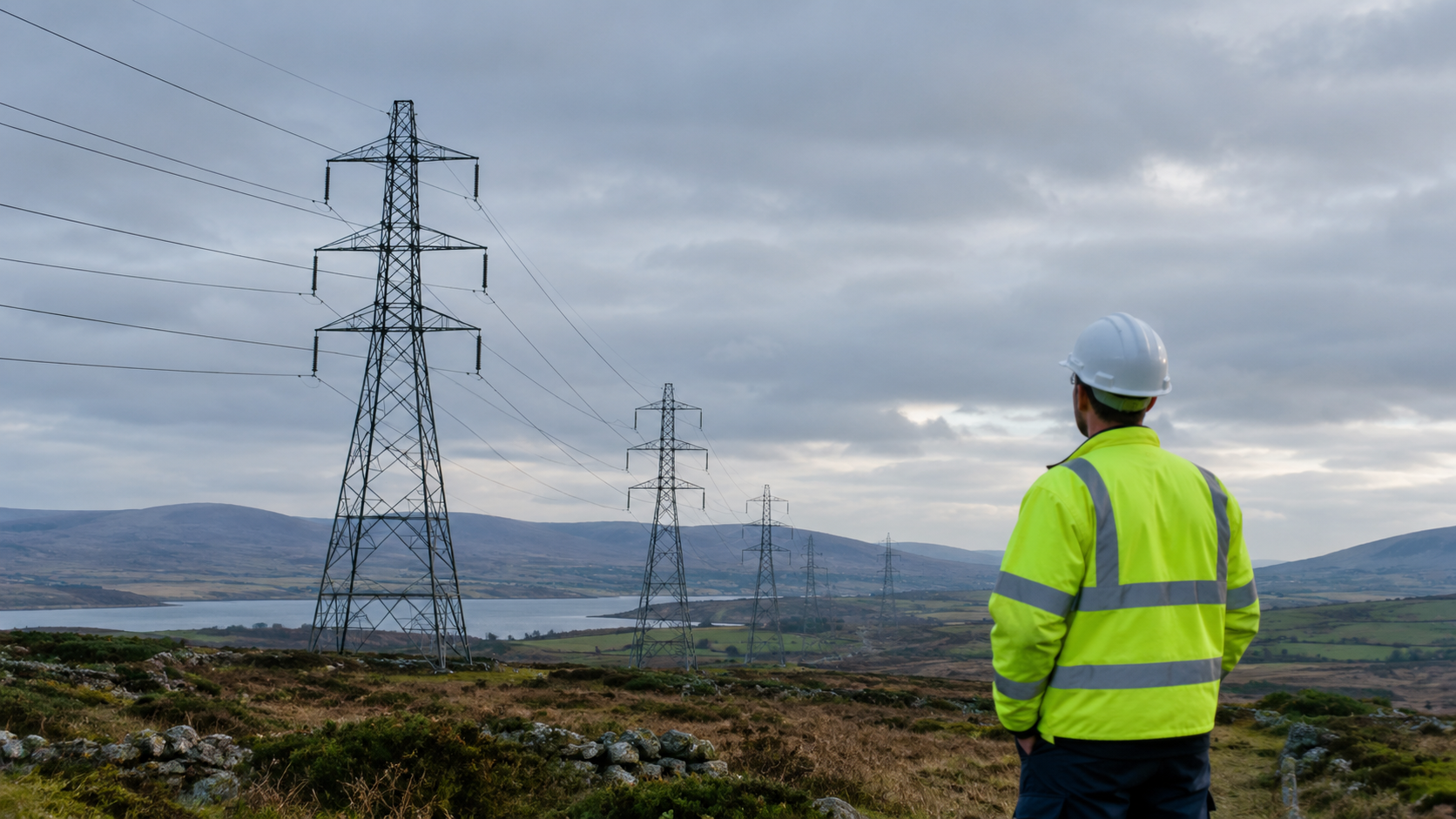
When you hear that ESB plans to invest approximately €20 billion by 2030, it is easy to file it away as another big infrastructure announcement.
But think about what has to physically happen for €20 billion to be spent.
Substations have to be built. Cables have to go into the ground. Existing networks have to be reinforced. Renewable projects need connections. New infrastructure has to be designed, constructed, commissioned and maintained.
And that's before considering the housing, industrial developments, transport infrastructure and other projects that need additional electricity capacity themselves.
So perhaps the more interesting question isn't where €20 billion is being spent.
It's what could that investment allow Ireland to build next?
First, where is the €20bn actually going?
ESB says it is planning approximately €20 billion of capital investment up to 2030 to support housing growth, economic expansion and Ireland's changing electricity system.
Up to €16 billion of that is expected to be directed towards electricity networks across the island of Ireland.
And this isn't something sitting in a plan waiting for 2030.
In the first six months of 2026 alone, ESB invested almost €1.5 billion in capital projects. More than €900 million went into electricity network infrastructure, while almost €500 million went into electricity generation, around 70% of which was invested in new renewable projects across onshore wind, offshore wind and solar.
The work is already moving.
But the scale of what comes next is considerably bigger.
What does that look like on the ground?
This is where the numbers become much more interesting for construction professionals.
Ireland's Price Review 6 programme covers the period from 2026 to 2030 and provides for up to €18.9 billion of investment in the national electricity grid and network.
The programme includes:
-
69 new or upgraded substations
-
80,000 electricity pole replacements
-
More than 300km of new underground cable
-
Hundreds of kilometres of new, upgraded or higher-capacity overhead lines
-
29 major transmission infrastructure projects
-
27 major distribution substations.
And behind every one of those figures is a construction project.
There are sites to prepare, civils packages to deliver, electrical infrastructure to install, programmes to manage, safety requirements to oversee, commercial decisions to make and specialist engineering work to complete.
One of the first examples is already operational.
The new Bracklone 110kV substation in Co. Laois was officially opened in July 2026 after a three-year construction period. It became the first new substation energised under PR6 and is one of 30 new 110kV substations included in ESB Networks' programme. More than 500 major capital projects are expected to be delivered under PR6 overall.
Multiply that activity across Ireland and the size of the construction challenge becomes easier to appreciate.
But here's where the story gets bigger
Electricity infrastructure isn't being expanded simply because Ireland wants a bigger electricity network.
It is being expanded because Ireland wants to build and electrify more of almost everything else.
Housing is probably the clearest example.
The electricity investment approved under PR6 is intended to help facilitate connections for up to 300,000 new homes by 2030. It is also expected to support up to one million electric vehicles and 680,000 heat pumps, alongside growing electricity demand from Ireland's population and industry.
That changes how we should look at electricity infrastructure.
A new housing development needs more than houses.
An industrial facility needs more than a building.
A major transport project needs more than concrete and steel.
They all need sufficient infrastructure around them to operate.
And increasingly, electricity capacity is part of that equation.
So while the immediate construction opportunity sits in building the grid itself, the longer-term impact could spread much further across Ireland's construction market.
Ireland is trying to build while electricity demand is rising
There is another challenge sitting in the background.
Ireland isn't upgrading a static electricity system.
Demand is growing at the same time.
EirGrid expects electricity demand to more than double by 2050, while increasing amounts of offshore wind, onshore wind, solar and battery storage will need to be accommodated on the system.
That means Ireland effectively has to do several things at once.
Maintain the network it already has.
Increase its capacity.
Connect new homes and businesses.
Accommodate significantly more renewable electricity.
Prepare for greater electrification of heating and transport.
And make the entire system more resilient.
That's a very different construction challenge from delivering one major project and moving on.
It points towards a multi-year infrastructure programme with work spread across different regions, disciplines and project types.
The renewable boom needs somewhere to plug in
Ireland's renewable ambitions also create an interesting knock-on effect.
Building a wind or solar project is only part of the job.
The electricity has to get from where it is generated to where it is needed.
As more renewable generation comes onto the system, Ireland needs the transmission infrastructure, substations, cabling, storage and grid capacity to accommodate it.
EirGrid describes the period to 2030 as the most extensive programme of work ever undertaken on Ireland's electricity system. Its current strategy is focused on expanding infrastructure while preparing the grid for substantially greater renewable generation and electricity demand.
For construction, that means the renewable opportunity isn't limited to the wind turbines or solar farms people immediately picture.
There is an entire layer of infrastructure behind them.
And much of it still has to be built.
So where could the opportunities actually be?
For someone working in Irish construction today, this doesn't necessarily mean you need to suddenly become an electrical engineer.
The scale of investment requires much broader expertise.
Civil engineers will be needed to deliver the physical infrastructure surrounding energy projects.
Site and project managers will be needed to coordinate increasingly complex programmes.
Quantity surveyors, estimators and commercial managers will have to manage costs and procurement across major capital works.
Health and safety professionals will be particularly important in environments involving high-voltage infrastructure and specialist construction.
Electrical engineers, commissioning engineers and HV specialists bring another layer of expertise that becomes increasingly valuable as the network expands.
There will also be work throughout the contractor, subcontractor, consultancy and supply chain markets.
That's what makes this particularly interesting from a career perspective.
You don't necessarily have to work in "energy" today for energy investment to influence the projects available to you tomorrow.
Could this change where construction demand appears?
Potentially, yes and this could be one of the more interesting things to watch.
Major construction demand in Ireland is often discussed through the lens of Dublin and other large urban centres.
Electricity infrastructure doesn't work like that.
Networks run across the country. Renewable generation is geographically dispersed. Existing infrastructure needs upgrading in different regions, while new housing and industry require additional connections.
The new Bracklone substation in Laois is a good early example of that.
EirGrid has also identified 29 priority projects as part of its current strategy, including major infrastructure intended to strengthen capacity in the North West.
As those programmes progress, construction professionals may find that some of the most interesting infrastructure opportunities aren't necessarily concentrated where they traditionally expect them to be.
There is also a less obvious part of the €20bn story: resilience
Ireland isn't only building for greater demand.
It is also rebuilding parts of the network to cope better with disruption.
Following the impact of severe weather, network resilience has become a significant part of infrastructure planning.
PR6 includes investment specifically aimed at improving the resilience and reliability of Ireland's electricity infrastructure, while ESB has increasingly emphasised the need to strengthen networks against extreme weather events.
That creates another stream of construction activity alongside expansion.
Some projects will add capacity.
Others will replace ageing infrastructure.
Some will connect renewable generation.
Others will make existing networks stronger.
Together, they create a much broader pipeline than the €20 billion headline initially suggests.
The real opportunity isn't the €20bn. It's what the €20bn enables.
That's perhaps the most important takeaway for Ireland's construction industry.
The headline figure is impressive.
But money itself doesn't create construction demand.
Projects do.
And behind Ireland's electricity investment is a growing list of physical projects that have to move from plans and budgets into construction.
More than 500 major capital projects.
New substations.
New transmission infrastructure.
Underground cabling.
Grid reinforcement.
Renewable connections.
Greater resilience.
And potentially the electricity capacity required to unlock thousands of homes and support further industrial and infrastructure development.
So over the next few years, it may be worth paying attention to Ireland's electricity network even if you've never considered yourself part of the energy sector.
Because one of the biggest influences on where Ireland builds next might be something most people never see.
The infrastructure powering it.
Get in Touch
Want to find out how we can help your business grow? Get in touch with us by sending a message through this form!Related Articles
119 Irish Regeneration Projects: Where Regional Construction Demand Could Grow Next
When people talk about the next wave of construction in Ireland, attention usually goes to the same places. Housing. Dublin. Data centres. Pharmaceutical projects. Major infrastructure. But one of the...
 Cathal McKeever
3 Must-Ask Questions to End Your Construction Interview
3 Must-Ask Questions to End Your Construction Interview When it comes to construction interviews, most candidates spend all their time preparing to answer tough questions. While that’s important...
Cathal McKeever
Are Construction Professionals Expected to Sacrifice Too Much?
Are Construction Professionals Expected to Sacrifice Too Much? Long hours. Long commutes. Constant pressure. Time away from family. ...
 Fionn Mac Néill
Are Data Centres the Golden Ticket? The Truth Behind Ireland's Most Talked-About Construction Sector
Are Data Centres the Golden Ticket? Walk into almost any construction site canteen, recruitment office, or industry event in Ireland today, and you'll hear the same conversation. ...
 Ryan Kieran
Are Your Construction Skills More Valuable Than You Think?
You'd Likely Be in Strong Demand Right Now When was the last time you stopped to think about your career? For most construction professionals, the answer is probably "not recently." Betwe...
 Stephen Nugent
Balancing Commute, Site Location & Career Growth in Ireland: Are You Optimising Your Construction Career?
The Decision That Can Shape Your Entire Construction Career It's Monday morning. Your alarm goes off at 5:15am. By 6am you're on the M50, heading towards a project that's over 90 minutes away. You tel...
Stephen Nugent
Breagh Recruitment: 10 Years in Construction Recruitment
Breagh Recruitment: 10 Years in ConstructionRecruitment – My Journey This October 2025, Breagh Recruitment turns ten and I couldn’t be prouder. But our story started long before the f...
Cathal McKeever
Breagh Recruitment 2025: A Year of Growth, Grit and Milestones
Breagh Recruitment 2025: A Year of Growth, Grit and Milestones As 2025 comes to a close, it’s a natural time to pause, reflect, and take stock of just how far Breagh Recruitment has come not jus...
Cathal McKeever
Breagh Recruitment Celebrates Excellence at the Irish Construction Industry Awards 2025
Breagh Recruitment had the privilege of attending the Irish Construction Industry Awards 2025 at the Convention Centre Dublin. It was a memorable even...
Cathal McKeever
Built by Humans, Run by Robots: The Engineering Wonder That Is Yangshan Port
Built by Humans, Run by Robots: The Engineering Wonder That Is Yangshan Port At Breagh, we live and breathe construction and engineering. But every now and then, we come across a project that makes ev...
Cathal McKeever
